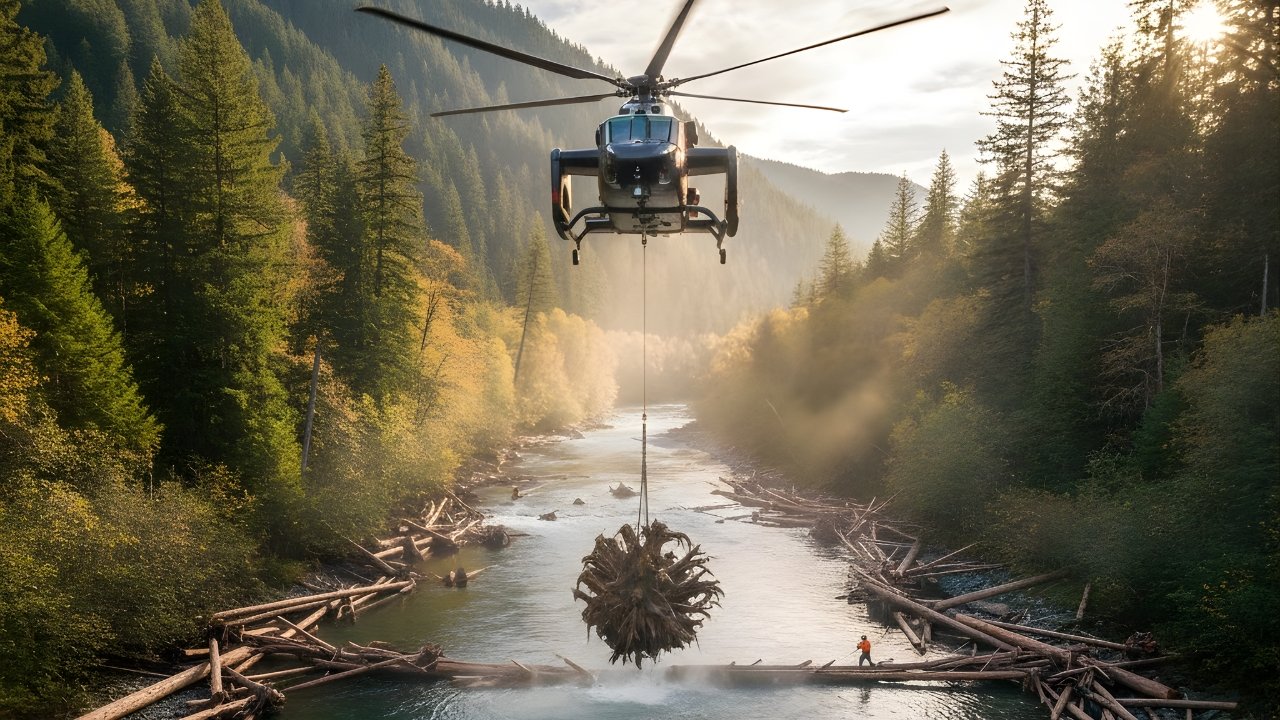
The U.S. Forest Service, in collaboration with tribal groups, has initiated an unprecedented aerial conservation effort on the Pacific Northwest in what they call a green restoration movement to recover a century of environmental destruction. All through 2025 and into early 2026, helicopters adding to tons of weight have been seen flying around and landing over remote river basins and dropping hundreds of thousands of straight Douglas fir and cedar trees directly into the water. The project is a transboundary watershed project managed across such rivers as the Little Naches River of Washington and the Clackamas River of Oregon, among others and is designed to reconstruct the “ecological architecture” of rivers that were cleared in the past to allow timber logging and navigation. Incorporating these logs back into nature by force, scientists are essentially jump-starting a natural process that would otherwise take centuries to take place.
Salmon Survival Log Jam Engineering
The main goal of this log dumping in the air is the restoration of severe salmon and steelhead habitats. Within a healthy river, the natural brakes to the water are the fallen trees that form “engineered log jam” as well. Devoid of this wood, rivers pass as highways to the sea where the fine gravel upon which the salmon require to hatch is swept away and the young fish are swept away down the stream before they can attain sufficient strength to resist. The well-location of the logs (usually dropped with root wads left in them) forms deep, cool pools and gives much needed protection against predators. These shallow waters are nurseries and the young salmon find a shelter here where they rest upon the insect infested decayed wood.
Reconstituting the “Natural Sponge” and Cooling Water
In addition to fish habitat, climate resilience includes a primary strategy which is the reintroduction of large woody debris. Scientists refer to healthy wood-filled rivers as sponge which makes water enter the adjacent floodplains and underground aquifers. This is referred to as alluvial infiltration and this process maintains high water table as well as ensuring that the cold filtered water percolates back into the river on hot summer days. With the increase of temperature around the world, these cool water refugia are turning out to be the survival and death of cold water species. The restoration project also has the effect of diminishing the catastrophic downstream floods by reconnecting these dry floodplains to the river during winter surges.
Leadership of the Tribe and the Revival of Tradition
This huge project is not only a federal program; it is a deep cultural healing process of Indigenous people, the Yakama Nation and the Cowlitz Indian Tribe. Salmon are a First Food to these communities and their decline has been a great cultural loss to them. The tribal leaders have collaborated with biologists to locate roadless locations that heavy machines cannot access and a helicopter is the only option that can perform the task. These activities usually start with ceremonies and prayers, a transition to the industrial management of the 20th century to the philosophy that considers the river as a complex living system that needs its natural messiness to flourish.
The Future of Aerial Restoration
The size of the 2026 operations is unprecedented. More than 6,000 logs are being moved to central Washington to restore 38 km to river life, and in the Klamath Basin, in California, similar efforts are underway using so-called cutting-edge mapping in order to identify precise drop zones. Although twin-engine helicopters are costly (some of the projects are subsidised to over 228000 dollars) new analysts maintain that the long-term economic paybacks greatly exceed the expenses. The value of restoration in self-sustaining salmon runs is that it helps the local fishing economies and allows the managed waterways to need fewer people and expensive human intervention on a regular basis, so maybe, sometimes, the best way to progress is to literally re-put the past into the water.
River Restoration Snapshot: 2025–2026
| Project Location | Primary Material | Impact Goal |
| Little Naches, WA | 1,000+ Douglas Fir Logs | Reconnect Floodplains |
| Clackamas River, OR | 400 Large Logs | Cooling Water/Fish Refuge |
| Klamath Basin, CA | Hundreds of Downed Trees | Spawning Gravel Retention |
Frequently Asked Questions
1. Is it better to use helicopters rather than trucks?
Most of the most important salmon habitats are found in wilderness areas that are roadless or in protected areas. Helicopters enable crews to install giant timbers without developing damaging roads and compressing delicate riparian soils.
2. Do not cause flooding in rivers by logs?
In fact, things are the opposite. These log jams decrease the speed and amount of water that arrives to the downstream communities at once by slackening the water and forcing it into the natural floodplains.
3. Is this permanent?
Yes. These are entire trees whereby the root systems are designed to interlock and take root into the riverbed. They accumulate more wood and sediment over time and form a self-supporting habitat which gets better with age.
Disclaimer
The information is informational in nature. To have official sources of information, you can visit such sources as NOAA Fisheries or U.S. Forest Service where you will find the technical reports; our intention is to give the correct information to everyone.
