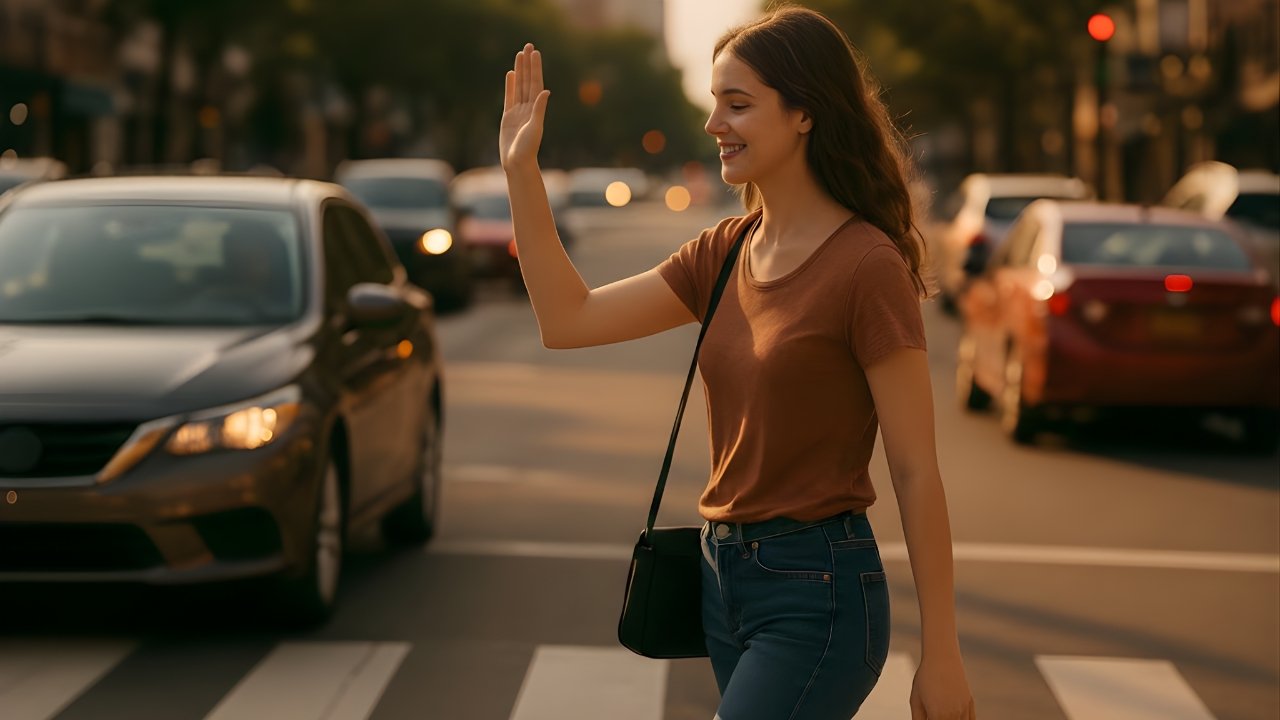
The mere act of lifting your hand to show appreciation to a driver on the street, as you cross it may seem a slight moment of courtesy, but according to psychologists this is a window into your social cognitive processing. Such a minor action acts as a prosocial signal, which means that a person has a high degree of situational awareness. Waving people usually accept that the road safety responsibility is shared where the driver has made the conscious decision to put the wellbeing of the pedestrian first. This is an empathic, social harmony seeking personality that is commonly grouped under the Agreeableness trait of the Big Five personality model.
Intense Caring and Reciprocity
Many people who have a reflex action of waving their hands to say thanks have a high internal need to feel that they owe someone. Psychologically, these individuals perceive the world in the concept of reciprocity; when an individual gives them the right of way, they have a mental obligation to even the score by giving them a reciprocation of a favor. This character is often associated with emotional intelligence (EQ). By returning the favors, the pedestrian is rewarding the patience of the driver making it less likely to encounter the road rage and creating a moment of meaningful human interaction in a seemingly lifeless urban atmosphere.
Conformity, Social Safety and Anxiety
On the one hand, it is perceived as a high level of kindness; nevertheless, certain psychologists believe that waving may be also the symptom of social anxiety or high level of harm avoidance temperament. The wave is not just a thank you to some people, it is their means to placate the driver to make sure they are safe. In this case, these individuals might be vulnerable when they are exposed in the crosswalk, hence using the gesture to humanize themselves to the one behind the wheel. Such a manner indicates that it is a very sensitive personality with a strong interest in ensuring a non-confrontational presence in social areas.
The “Main Character” vs. The Collective Mindset
On the other hand, not having a wave does not automatically imply that he or she is rude, but it can also serve to emphasize various personality archetypes. Wave-less people might have a utilitarian mentality and they may see the cross walk as a legal provision and not a social interaction. The wavers however are usually more inclined towards a collectivist viewpoint where they consider themselves to be part of a dynamical ecosystem. This group is more other oriented as it always tries to find solutions to smooth the social tensions. They are the same individuals that will tend to hold doors open or even smile at a stranger and support a community oriented personality rather than the individual.
Long-term Gentler Benefits of Micro-Gratitude
It has been found that such small acts of thankfulness positively affect the mood of a pedestrian and a driver, engaging them into these “micro-gestures of thankfulness” helps to improve the mood of both parties involved. This is psychologically a positive feedback loop. Your brain can release a little burst of dopamine that is connected with social bonding when you wave. In the long run, this habit will be able to transform your personality into a more positive and strong one. When you decide to appreciate the cooperation of a stranger, you are training your brain to see the “good” in the world, which is a characteristic of a healthy, well-adjusted psychological profile that is oriented to the external relationship and not to the internal isolation.
Data Insights: Ped Behavior
| Trait Observed | Likely Personality Driver | Frequency |
| The Wave | High Agreeableness / Empathy | High |
| The Nod | Efficiency / Respect | Medium |
| No Gesture | Task-Orientation / Autonomy | Low-Medium |
Frequently Asked Questions
1. Does not waving imply that I am an un-good person?
Not at all. It simply usually entails being destination oriented or looking at the traffic laws as an established standard that does not need individual recognition.
2. Is this behavior cultural?
Yes. In societies characterized by high-trust, people use waving as a conventional social lubricant, but in city centres where people are very busy, pedestrians tend to be anonymous in order to be effective.
3. Will waving actually help me to be safer?
Psychologically, yes. Eye contact and gesticulation will help in making the driver notice you and this give rise to a cognitive safety contract between the driver and yourself.
Disclaimer
The information is informational in nature. To verify that the information is correct, you may consult such official sources as the American Psychological Association (APA) or the Association of Psychological Science; it is our goal that the information should be relevant to all users. There might be variations of professional psychological analysis depending on the circumstances and cultural conditions.
