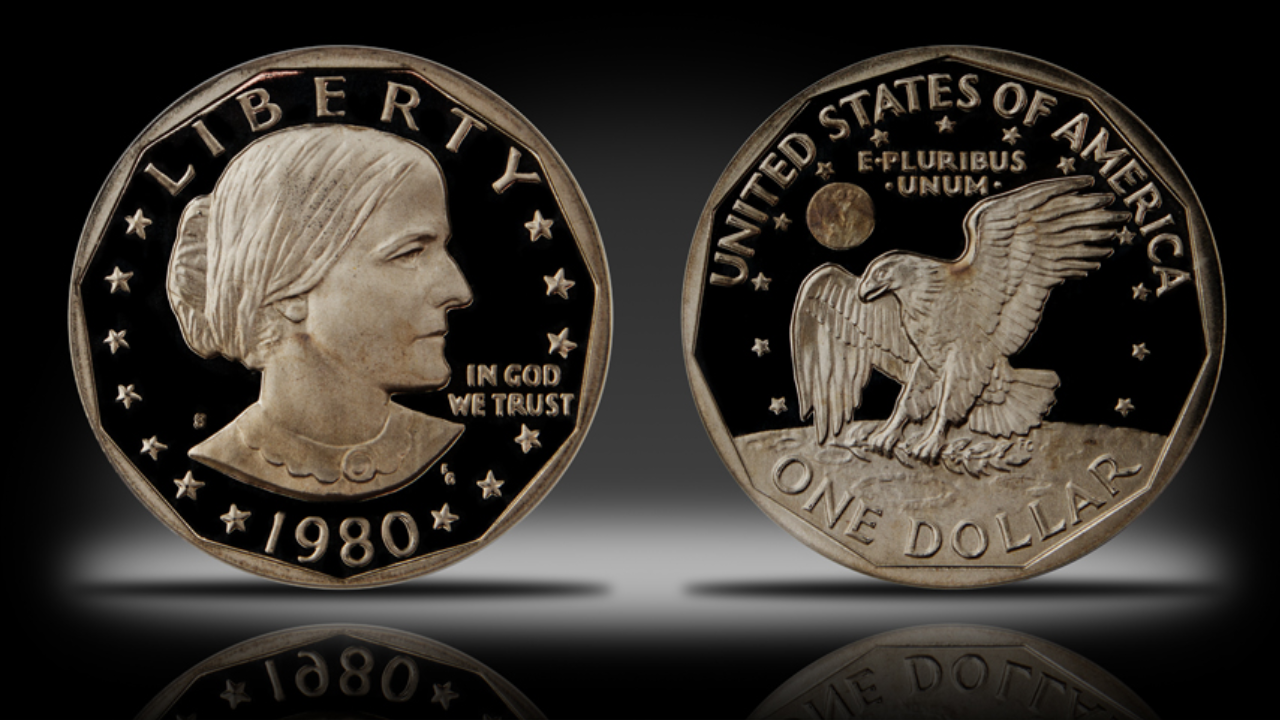
The 1980-S Susan B. Anthony $1 Proof Dollar stands out as a gem from the U.S. Mint’s short-lived experiment with small dollar coins. Minted in San Francisco, this perfect uncirculated piece honors the pioneering women’s rights leader whose face broke tradition on American currency. Collectors prize its sharp details and mirror-like finish, marking a brief era of innovation in coin design.
Birth of a Controversial Coin
Introduced in 1979 under President Jimmy Carter, the Susan B. Anthony dollar aimed to replace bulky Eisenhower dollars and paper bills in vending machines. Its smaller size mirrored quarters, sparking confusion that doomed circulation versions to obscurity. Proof strikes like the 1980-S version fared better, appealing to numismatists seeking pristine quality from the get-go.
Design Features That Captivate
Frank Gasparro crafted both obverse and reverse, showing Anthony in profile with flowing hair and determined gaze. Liberty wraps around the top, while “In God We Trust” sits near her chin, framed by stars. The reverse eagle soars amid olive branches and “United States of America,” with “One Dollar” boldly inscribed below.
Technical Specs at a Glance
| Feature | Details |
|---|---|
| Denomination | $1 U.S. Dollar |
| Mint | San Francisco (S mark) |
| Mintage | 3,554,806 proof sets |
| Composition | Copper-nickel clad over copper |
| Diameter | 26.5 mm |
| Weight | 8.1 grams |
| Finish | Proof (mirror fields, frosted devices) |
Over 3.5 million entered proof sets, keeping common pieces affordable at $5 to $20 in top grades. Deep cameo contrasts push premiums to $50 or more for elite specimens. Its scarcity stems from the program’s abrupt end in 1981, revived only once in 1999 for niche needs like transit vending.
Collecting Appeal Today
Numismatists hunt pristine uncirculated proofs for type sets or Anthony collections. PCGS and NGC slabs preserve their perfection, shielding against toning or marks. Recent auctions show steady demand, especially as women’s history gains spotlight in education and culture.
Market Trends and Investment Sense
Values hold firm amid economic shifts, with inflation boosting metal appeal. Entry-level collectors snag deals under $10 raw, while graded gems climb with quality. Pairing with 1979-P or D counterparts builds affordable runs from the series’ three-year span.
Preservation Tips for Owners
Store in albums away from air and light to dodge haze. Handle by edges only, using cotton gloves for inspections. Professional grading elevates resale, certifying that “perfect uncirculated” status promised by savvy sellers.
FAQs
Q1: What makes 1980-S proofs special?
Mirror finish and cameo contrast set them apart from circulation strikes.
Q2: How much is it worth today?
$5-$20 common; $50+ for top grades.
Q3: Why did the coin fail?
Size too close to quarters caused mix-ups in daily use.
Disclaimer
The content is intended for informational purposes only. You can check the official sources; our aim is to provide accurate information to all users.
